By Wendy Campbell, Director of Marketing | Automated Business Technologies | Access Control, Manufacturing & Distribution
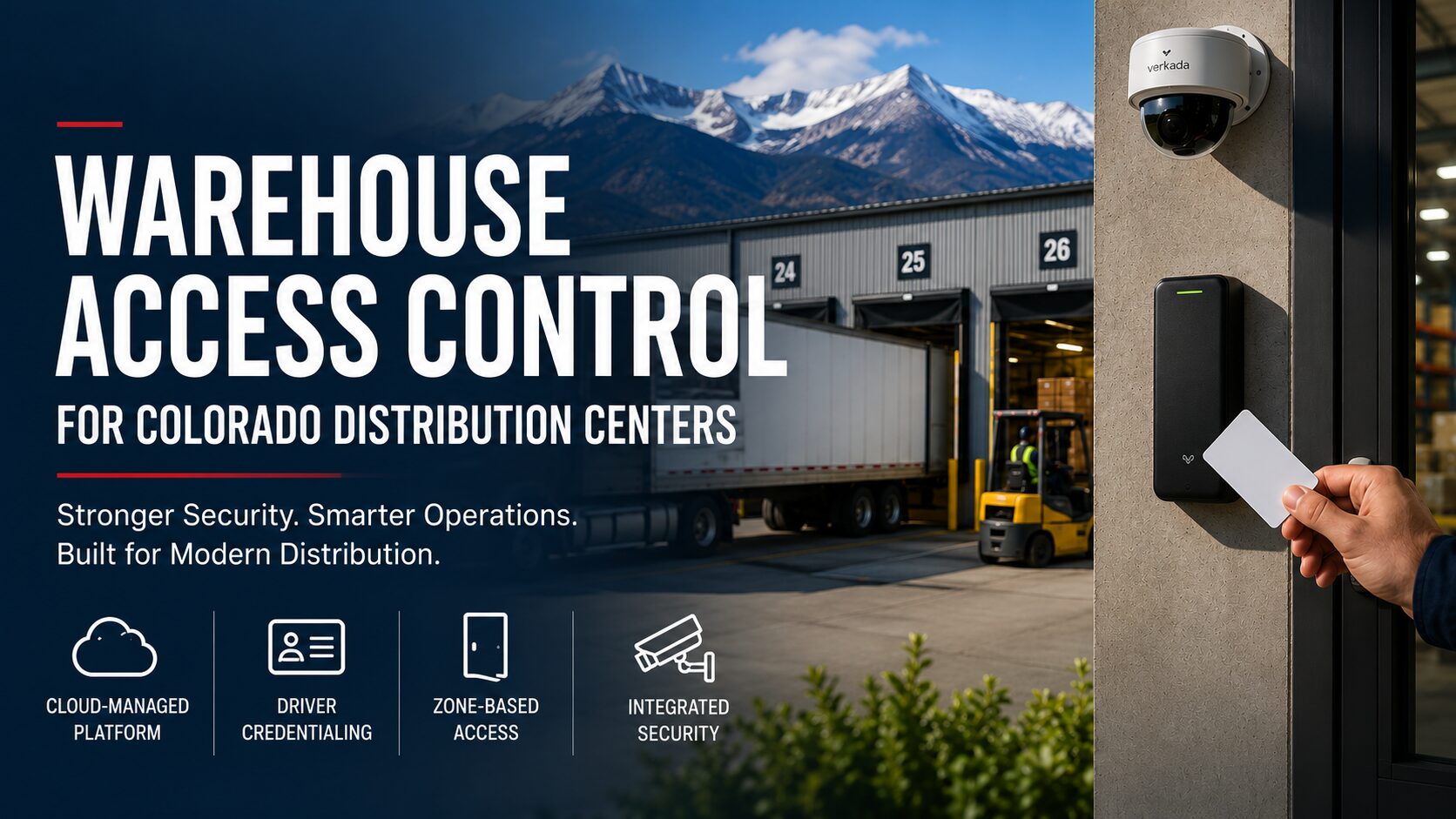
Forty percent of businesses experienced a physical security breach in 2024 — and for warehouses and distribution centers, the numbers run even higher. Dozens of entry points, a rotating cast of drivers and contractors, and inventory that’s worth stealing all add up to a facility that’s structurally harder to secure than a typical office. Most of the Colorado distribution operators we talk to are still managing that risk with a mix of physical keys, a DVR nobody checks, and a gate log on a clipboard.
This post covers what modern warehouse access control actually does, where distribution centers get exposed that office buildings don’t, and how Verkada’s cloud-managed platform fits a Colorado facility running receiving docks, shift changes, and multiple buildings across the Front Range.
|
Quick Answer
Warehouse access control is a zone-based security system that manages who can enter a distribution center’s dock doors, pedestrian entrances, and restricted storage areas — and when. For Colorado facilities, cloud-managed platforms like Verkada replace on-site servers with a single dashboard that handles multi-site door access, driver credentialing, and camera integration, typically running $2,500–$15,000+ depending on door count, camera coverage, and number of sites.
|
On This Page
Why Warehouses and Distribution Centers Are Different
An office building has a lobby, a badge reader, and a fairly predictable population of people who come through it every day. A distribution center has none of that consistency. Inbound and outbound carriers rotate daily. Seasonal and temp labor turns over constantly. Dock doors sit open for hours at a time during loading. And the inventory behind those doors is usually worth a lot more than the office equipment one floor up in a corporate building.
That combination — high traffic, high turnover, high-value goods, and a building designed for throughput rather than containment — is exactly why generic office security doesn’t translate well to a warehouse floor. A single badge reader at a front door doesn’t do anything for a dock that has six bays, a yard gate, and a night shift running when the office staff has gone home.
|
The Night Shift Problem
Industry security data shows roughly 60% of warehouse break-ins happen during the overnight window between 10 PM and 6 AM, with employee theft concentrated around shift changes and lunch breaks. A facility that relies on a locked door and an alarm panel has no way to reconstruct who was actually on the floor during those hours — which is exactly when most incidents happen.
|
What Warehouse Access Control Actually Covers
“Access control” for a distribution center is broader than a badge reader on a front door. A complete system typically addresses five distinct entry types, each with different risk profiles and different rules:
|
Dock Door Management
Time-of-day schedules tied to carrier appointment windows — inbound drivers get access during receiving hours, outbound during shipping, and doors lock out entirely when the dock is closed.
|
Pedestrian Entry Control
Separates warehouse floor staff from office and administrative areas, so a picker or forklift operator’s badge doesn’t open the same doors as an HR or finance employee’s.
|
|
Driver & Carrier Credentialing
Temporary, scoped credentials for drivers and vendors that expire automatically — no permanent badges floating around outside your own workforce.
|
Secure Inventory Zones
Extra restriction on high-value cages, controlled substances, or serialized inventory — access limited to specific roles, logged every time.
|
|
After-Hours Lockdown
One command that secures every entry point across a large facility footprint at close of business — not a manager walking the building checking doors.
|
Camera-Linked Events
Every door event tied to a video clip — not just a log entry saying who badged in, but visual confirmation of what actually happened.
|
A system that only handles one or two of these — say, a badge reader on the front office door and nothing else — leaves the dock, the yard, and the floor exactly as exposed as they were with a physical key.
Zone-Based Access: What Goes Where
The core idea behind a well-designed warehouse system is that not every employee, contractor, or visitor needs — or should have — the same level of access. Zone-based permissions tie access to job function instead of convenience:
| Zone | Typical Access |
| Front office / admin | Office staff, management — standard business hours |
| Warehouse floor | Floor staff, supervisors — shift-based schedules |
| Dock doors / bays | Receiving/shipping staff, credentialed drivers — appointment-window only |
| High-value / restricted cage | Named individuals only — full audit trail |
| Server / IT / electrical rooms | IT and facilities staff only |
This is also where a permissions audit process matters. Warehouses churn through seasonal labor and third-party service providers constantly, and if nobody reviews who still has access after a role ends or a contract wraps, permissions drift fast. A quarterly review of who has access to what is a cheap habit that closes a gap most facilities don’t know they have.
|
Not sure where your facility’s exposure actually is?
ABT’s free security assessment maps your doors, dock, and camera coverage — then recommends a platform and budget range. No obligation.
|
Why Cloud-Managed Access Control Fits a Distribution Operation
Traditional access control for a building this size usually means a server closet, on-site software, and an IT team on call to manage firmware and hardware failures. That’s a heavier lift than most distribution operators want to carry — especially at a facility where IT is already stretched thin managing the WMS, the network, and everyday support tickets.
Verkada’s cloud-managed platform removes the server entirely. ABT deploys it as a Verkada Authorized Partner across Denver, Colorado Springs, and Westminster, and for a warehouse or distribution center specifically, three things matter more than they would in a standard office:
|
Multi-Site Management
Distribution operators running more than one Colorado facility manage every door and camera from a single dashboard — no separate login for each site.
|
Remote Lockdown
A shift supervisor or security lead can lock down every door in the building from a phone — no walking the facility physically checking each entry point.
|
Video-Linked Audit Trail
Every dock door and cage event pairs with camera footage — so shrinkage investigations start with a clip, not a guess.
|
This isn’t a hypothetical need. Cargo and inventory-related fraud has become more sophisticated in the last two years — some industry reporting points to logistics identity fraud spiking more than 200% over that window, often through criminals posing as legitimate drivers to walk off with a loaded trailer. A credentialing system that verifies and expires driver access automatically closes a door that a clipboard sign-in sheet leaves wide open.
Common Mistakes Colorado Facilities Make
Most of the gaps we find during a warehouse security assessment fall into a handful of repeat patterns:
|
Watch For
Treating the whole building as one zone. A facility with high-value electronics, pharmaceuticals, or serialized inventory needs an extra layer on those specific areas — not the same access level as the general floor.
Ignoring the dock and yard. Most access control conversations start and end at the front door. The dock — where the actual inventory moves — is usually the least controlled part of the building.
No offboarding process for seasonal or temp labor. Access that isn’t revoked the day someone’s contract ends is access that shouldn’t exist anymore.
|
What It Costs and How to Get Started
Pricing depends on door count, camera coverage, number of sites, and whether you’re retrofitting an older building or specifying a new one. Verkada is licensed per device with cloud storage and software included, so there’s no separate server cost to budget for. A single-site warehouse with a handful of doors and dock bays typically lands in a different range than a multi-site distribution network — which is exactly why ABT starts every project with a site assessment rather than a generic price sheet.
Older Colorado facilities that weren’t built with electronic access in mind aren’t a dealbreaker — a phased retrofit is usually the more practical path than a full rip-and-replace, and it lets you prioritize the dock and high-value zones first.
|
Get a platform recommendation and budget range for your facility.
Tell ABT about your buildings — door count, dock configuration, and site count — and get a no-obligation recommendation with real budget numbers.
|
|
The ABT Difference
ABT is a Verkada Authorized Partner with local teams in Denver, Colorado Springs, and Westminster — so site assessments, installation, and ongoing support come from a team that shows up, not a national contractor passing through. Distribution and manufacturing facilities across the Front Range already rely on ABT for the same managed IT and cybersecurity coverage that protects the network your access control system runs on.
|
Frequently Asked Questions
|
What’s the difference between warehouse access control and a standard office system?
Office access control mostly covers a lobby and a handful of interior doors. Warehouse access control has to account for dock doors, yard gates, driver and carrier credentialing, and zone-based restrictions on high-value inventory — a much larger and more varied set of entry points.
|
Do we need cameras and access control together, or can we choose one?
They work independently, but pairing them closes the biggest gap in either system alone: access control tells you who badged in, cameras show you what actually happened. Verkada runs both on one platform, so events and footage are already linked.
|
|
Can we manage access across multiple Colorado facilities from one dashboard?
Yes — this is one of the main advantages of a cloud-managed platform. Doors, cameras, and permissions across every site are visible and manageable from a single login, with policies standardized across locations instead of managed one by one.
|
How do we handle temporary drivers and seasonal warehouse staff?
Cloud platforms support scoped, temporary credentials that expire automatically — a driver or seasonal employee gets access for exactly the window they need it, with no permanent badge left active after the job ends.
|
|
Is our older building too outdated for electronic access control?
Not usually. Many Colorado warehouses weren’t built with electronic access in mind, but a phased retrofit — starting with the dock and highest-risk zones — is a practical, lower-disruption path compared to replacing everything at once.
|
What does ABT handle versus what our team manages day to day?
ABT leads the site assessment, platform design, installation, and training. Your team retains day-to-day control — managing credentials, reviewing footage, and responding to alerts — while ABT’s local Colorado teams handle ongoing support and hardware needs.
|
|
Bottom Line
A warehouse or distribution center is a different security problem than an office — more doors, more turnover, more value behind those doors, and a night shift running when nobody’s watching. Cloud-managed access control from a Verkada Authorized Partner closes that gap without adding a server room to maintain. The first step is a site assessment, not a purchase decision.
|
Get a Free Security Assessment for Your Colorado Facility
|
Cloud-Managed Access Control for Colorado Distribution Centers
Verkada Authorized Partner | No DVR, no on-site server | Local Denver, Colorado Springs & Westminster teams
Tell us about your doors, dock, and camera coverage — we’ll recommend the right platform and a budget range. No obligation.
|
|
Related reading: Verkada Cloud Security Cameras for Colorado Businesses | Access Control Badge Panels: Door Controllers Explained | Manufacturing Technology Solutions for Colorado | Cybersecurity for Colorado Businesses
|
Wendy Campbell
Director of Marketing, Automated Business Technologies
Wendy leads marketing strategy for ABT, a locally owned managed technology provider serving Denver, Colorado Springs, and Westminster since 2005 — covering managed IT, cybersecurity, access control, managed print, and cloud communications for Colorado businesses.
|