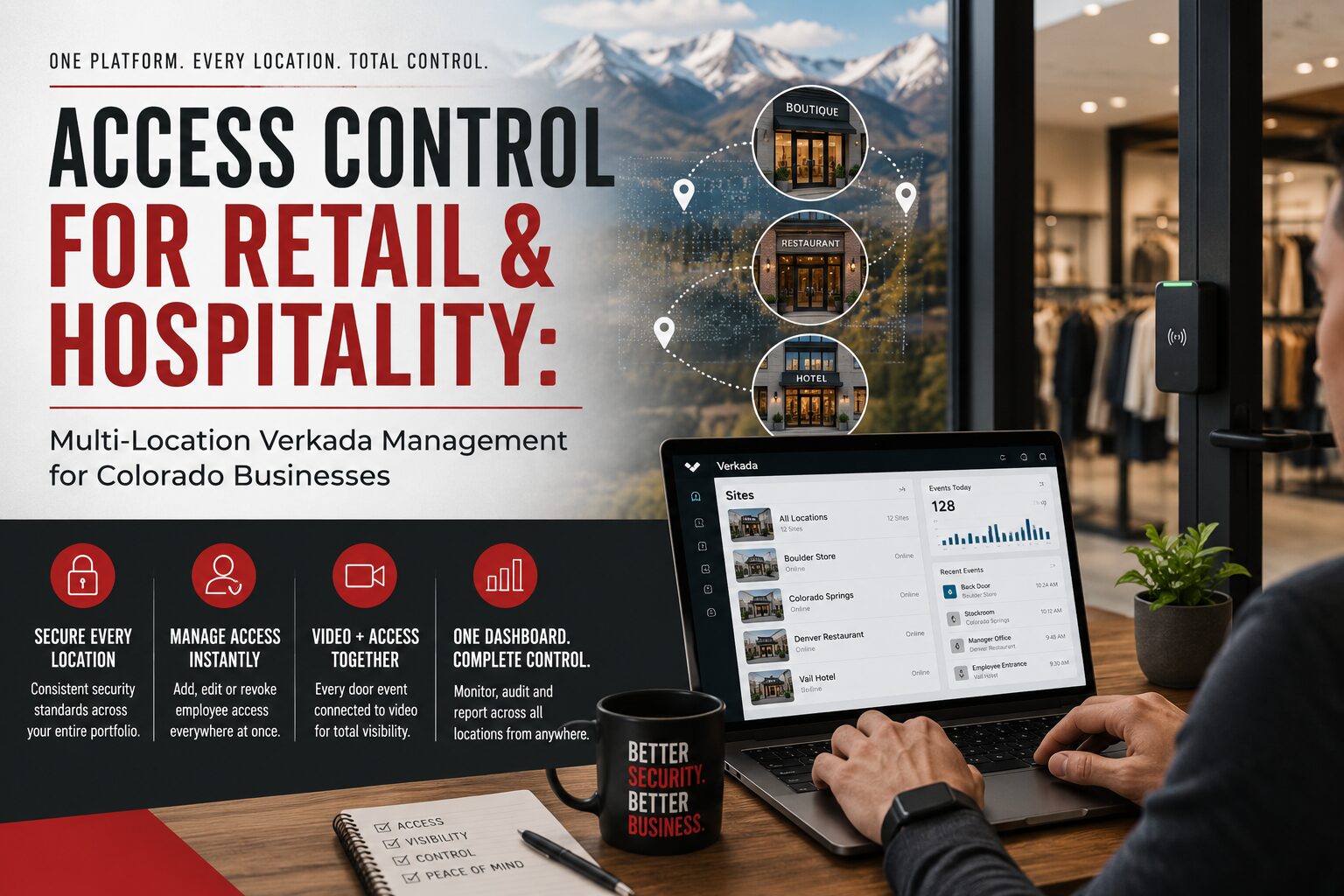
Access Control for Retail & Hospitality: Multi-Location Verkada Management for Colorado Businesses
|
Quick Answer Multi-location retail and hospitality businesses in Colorado need one access control platform, not one per store. Cloud-managed systems like Verkada let you revoke a terminated employee’s access at every location instantly, tie video to every door event for loss prevention, and onboard a new store in an afternoon instead of a separate install project. The standardization is the point — not any single feature. |
In This Guide
- The Multi-Location Access Control Problem
- Why Retail & Hospitality Are Different
- What a Centralized Platform Actually Solves
- What Standardizing Actually Costs
- Retail-Specific Considerations
- Hospitality-Specific Considerations
- Common Mistakes When Scaling Access Control
- How ABT Implements This Across Colorado Locations
- FAQs
The Multi-Location Access Control Problem
Ask a three-location retail or restaurant operator who has the back-door code, and the honest answer is usually “everyone” — current staff, the manager who left last spring, the vendor who was told once, maybe the previous tenant. Store A is on physical keys. Store B has a keypad code nobody’s changed since the last remodel. Store C has a standalone card reader and nobody remembers the admin password. Nothing has gone wrong yet, but there’s no way to know who can get in, and no record of who did.
That patchwork is the default state for most multi-location retail and hospitality businesses, because access control usually gets added store by store, by whoever happened to be doing the buildout at the time. Each location ends up with different hardware, different vendors, and no shared visibility. The fix isn’t a better lock at any one store — it’s one platform across every store.
Why Retail & Hospitality Are Different
Every multi-site business benefits from centralized access control, but retail and hospitality carry a few pressures that make the mismatched-system problem more expensive to ignore:
- Staff turnover is high and constant. Retail and hospitality have some of the highest employee turnover rates of any industry, which means credentials need to be issued and revoked constantly — not something a physical rekey process can keep up with.
- Loss prevention depends on knowing who was where, when. Stockrooms, cash offices, and back-of-house areas need an access log tied to video, not just a lock.
- Guests and customers are on-site too. Hospitality in particular has to balance a welcoming front-of-house experience with real restrictions on staff-only and back-of-house areas.
- POS and payment systems raise the stakes of a physical breach. A compromised back office isn’t just a break-in — it can be a path to point-of-sale hardware and cardholder data.
What a Centralized Platform Actually Solves
The value of a platform like Verkada’s cloud-managed access control for a multi-location business isn’t any single feature — it’s that every store runs on the same system, managed from the same dashboard.
- Instant, portfolio-wide credential changes. When an employee transfers between locations or is terminated, access updates everywhere at once — no driving between stores collecting keys.
- Mobile credentials instead of keycards. Staff use their phones, which means nothing to print, distribute, or collect during an exit interview.
- Video tied to every door event. When someone badges into a stockroom or cash office, footage is automatically tied to that event — critical for loss prevention investigations.
- One audit trail across every site. Every access event across the portfolio lands in a single log, instead of three or four separate systems you’d have to check individually.
- A known setup process for new locations. Opening a new store becomes an afternoon of configuration on an existing platform, not a new install project from scratch.
|
Why This Matters More in 2026 Industry research on distributed retail, hospitality, and payments environments points to third-party systems — POS integrators, booking engines, guest management platforms — as an increasingly common entry point for a breach, with roughly 42% of hotel IT and security leaders naming third-party vulnerabilities as their top risk. A physical access control gap at even one location can become the way in. |
|
Running access control differently at every location? ABT will map your current setup across every site and show you what standardizing on one platform actually looks like — no obligation. |
What Standardizing Actually Costs
Multi-location operators often assume standardizing access control means an expensive rip-and-replace project. In practice, the numbers are more approachable than most business owners expect.
| Cost Category | Typical Range | Notes |
| Per-door installation | $2,500–$4,500 | Reader, controller, lock hardware, and cabling; varies by door type and existing infrastructure |
| Cloud platform management | Flat, per-site or per-device | No on-site server or NVR required |
| New location rollout | Configuration, not a new project | Same hardware standard, same admin console, same credential types |
The bigger cost is usually the hidden one: staff hours spent re-keying locks after a bad termination, driving between stores to change codes, or piecing together video and access logs from three different systems after an incident. Standardizing on one platform doesn’t just reduce the security gap — it removes recurring administrative overhead that most multi-location operators have simply learned to live with.
Retail-Specific Considerations
- Stockroom and cash office access should be restricted to specific roles and time windows, not “everyone who works here.”
- Foot traffic and door-usage analytics from access and camera integration can flag unusual after-hours activity automatically.
- Delivery and vendor access for loading docks and back entrances benefits from time-limited or scheduled credentials rather than a code everyone knows.
- High seasonal staffing swings (holiday hiring, seasonal closures) are much easier to manage with mobile credentials that expire automatically than with physical keys that need to be collected.
Hospitality-Specific Considerations
- Staff-only and back-of-house areas — kitchens, laundry, cash handling, server rooms — need clear separation from guest-facing spaces without making the property feel locked down.
- High staff turnover and seasonal hiring make instant credential issuance and revocation especially valuable across a hospitality group’s properties.
- Third-party systems — booking engines, property management software, guest Wi-Fi — expand the attack surface beyond the front door, which is why access control should be planned as part of a broader security and network posture, not in isolation.
- Multi-property consistency matters for brand standards as much as security: the same access policies, badge types, and escalation process at every location make training and audits far simpler.
|
Warning The most common mistake multi-location operators make isn’t choosing the wrong platform — it’s letting each new location pick its own system because it was faster at the time. Every one-off installation is a future gap in the audit trail and one more login someone has to remember during an investigation. |
Common Mistakes When Scaling Access Control
- Letting each store choose its own vendor because it was convenient for that one buildout — this is how three-location businesses end up with three different systems.
- Treating access control and camera systems as separate purchases when they should share infrastructure and tie events together from day one.
- No fallback plan for mobile credentials. A dead phone shouldn’t lock an employee out — every location needs a manager override or backup credential path built in from the start.
- Never revisiting who has access. Access lists accumulate former employees and outdated vendor credentials unless someone owns a regular review.
|
Opening a new location this year? Build access control into the buildout from day one instead of retrofitting it later. ABT designs, installs, and supports Verkada deployments across Colorado. |
How ABT Implements This Across Colorado Locations
ABT designs and supports Verkada deployments for retail and hospitality businesses with multiple Colorado locations, from a single expanding storefront to a multi-property hospitality group. The approach is the same regardless of size: assess every site, standardize on one hardware and credential model, and document it so the rollout is repeatable at the next location.
That includes coordinating with your existing network and cybersecurity posture, since access control, POS systems, and guest Wi-Fi often share the same network infrastructure and need to be segmented correctly. For a broader look at Verkada’s feature set beyond multi-location management — facial recognition alerts, license plate detection, environmental sensors — see ABT’s Verkada access control overview for Colorado businesses.
ABT’s three Front Range offices — Centennial/Denver, Colorado Springs, and Westminster — mean a multi-location Colorado business gets one local partner for every site, rather than juggling regional installers for each new location.
|
Bottom Line Multi-location retail and hospitality businesses don’t need better locks at any one store — they need one platform, one credential system, and one audit trail across every location. The businesses getting hurt aren’t the ones spending too little on access control; they’re the ones with a different answer at every store when someone asks who has the door code. |
|
Ready to standardize access control across your locations? Tell ABT how many sites and doors you manage, and get a straight answer on what standardizing actually costs — no obligation. |
Frequently Asked Questions
What does multi-location access control cost for a small retail or hospitality chain?
Per-door installation typically runs $2,500–$4,500 depending on door type and existing infrastructure, with cloud platform management billed as a flat per-site or per-device fee rather than a per-door monthly charge. Opening additional locations after the first is usually configuration on the existing platform, not a new project.
Can I manage access control across multiple Colorado locations from one dashboard?
Yes. Cloud-managed platforms like Verkada are built specifically for this — whether you manage two locations or two hundred, you get a single dashboard with consistent policies, credential types, and audit logs across every site.
How does access control help with retail loss prevention?
When access control is integrated with video, every badge event at a stockroom, cash office, or restricted area is automatically tied to footage of that event. This gives investigators a timestamped, searchable record instead of hours of unindexed camera footage.
What happens if an employee’s phone dies and they can’t use their mobile credential?
Every location should have a fallback path built in from the start — typically a manager override, a backup physical credential kept on-site, or a PIN option at the reader. This should be planned during design, not improvised during an actual lockout.
Why is hospitality access control different from a typical office building?
Hospitality properties have to separate guest-facing areas from staff-only and back-of-house spaces without creating a locked-down feel, manage high seasonal staff turnover, and account for third-party systems like booking engines and property management software that expand the security perimeter beyond the front door.
Do all my locations need the same access control hardware?
Standardizing on the same hardware, network configuration, and credential types across every location is what makes multi-site management practical. It means your team trains on one system, spare parts are interchangeable, and opening a new location is a known process instead of a one-off project.
|
Wendy Campbell Director of Marketing, Automated Business Technologies (ABT). ABT is a Verkada Authorized Partner serving Colorado businesses since 2005 from three Front Range offices in Denver/Centennial, Colorado Springs, and Westminster. |