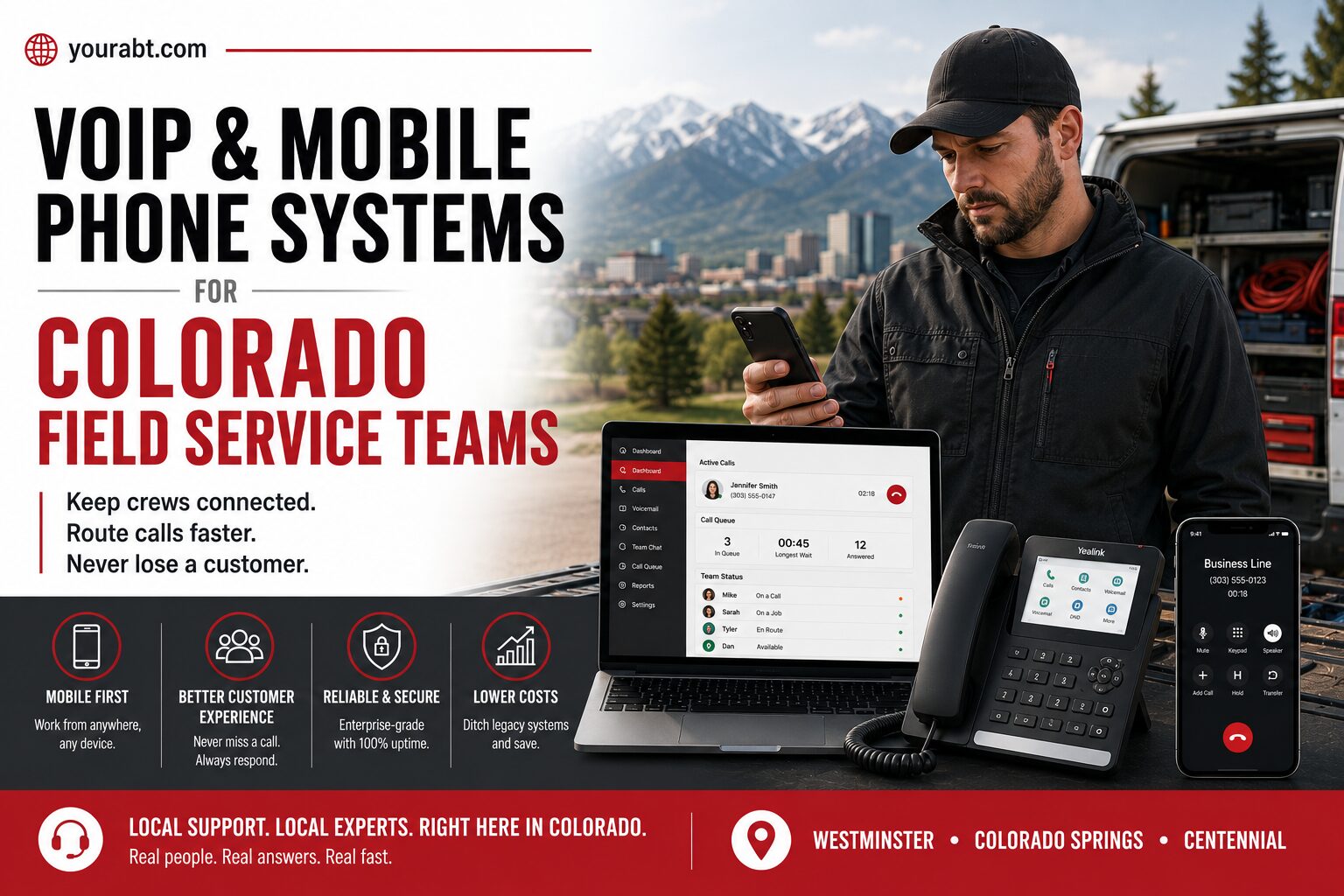
Quick Answer: Colorado field service teams — contractors, HVAC, plumbing, restoration, and other mobile-first businesses — need a phone system that works the way their crews do: from a truck, a jobsite, or a customer location, on any device, using one business number. Crexendo UCaaS delivered by ABT gives field teams a fully mobile business phone system with 100% uptime guarantee, mobile app, desktop app, and optional desk phones — all supported locally by ABT’s three Front Range offices. Pricing typically starts around $20–35/user/month, well below what most Colorado businesses currently pay for legacy landline infrastructure.
In This Guide
1. Why Standard VoIP Isn’t Enough for Field Service Teams
2. What Colorado Field Service Businesses Actually Need in a Phone System
3. How Crexendo UCaaS Addresses Field-Specific Requirements
4. Legacy PBX vs. UCaaS: What It Costs Colorado Field Teams to Stay Put
5. The Mobile App Is the Dispatcher’s Best Tool
If your crews leave the building at 7 AM and don’t come back until 5 PM, you can’t afford a phone system that only works at a desk.
Colorado field service businesses — HVAC, plumbing and mechanical, electrical, restoration, pest control, landscaping, property management — have a communication problem that most office-oriented phone systems were never designed to solve. Dispatchers need to reach technicians instantly. Customers expect callbacks from a business number, not a personal cell. Project managers need to know whether someone’s on a job, en route, or unavailable.
Legacy PBX systems keep teams tethered to a desk. Generic app-based VoIP tools lack the call routing, extension structure, and reliability that field operations require. And stitching together a personal cell, a Google Voice number, and a desk phone at the office creates exactly the accountability and professionalism gaps that cost Colorado service businesses customers.
This guide explains what a purpose-built cloud phone system looks like for Colorado field service teams, why Crexendo UCaaS is ABT’s primary recommendation for mobile-first businesses, and what it realistically costs to deploy — and to keep running a legacy system instead.
Why Standard VoIP Isn’t Enough for Colorado Field Service Teams
Most VoIP content you’ll find online was written for office teams. It talks about replacing desk phones, integrating with Outlook, and reducing per-seat costs. That’s fine if your team sits at a workstation all day.
Field service is a different problem. Here’s what it actually looks like:
|
The Dispatcher Problem Your dispatcher tries to reach a tech. The call goes to voicemail. They try the personal cell. The tech doesn’t answer because they’re under a crawl space. Customer calls back asking for an ETA. Dispatcher has no answer. Customer cancels. |
The Brand Problem Techs use their personal cell numbers. Customers save that number. When that tech leaves, the customer calls the tech — not the business. You’ve just lost the customer relationship you paid to build. |
|
The After-Hours Problem Emergency calls come in at 9 PM. The office line rings to voicemail. The on-call tech’s personal cell number isn’t posted anywhere. The prospect calls your competitor instead. |
The Scaling Problem You hire three new techs. With a legacy PBX, that means new hardware, wiring, and a service call. With personal cells, there’s no extension structure, no call routing, no accountability. You’ve just made the problem bigger. |
A UCaaS platform solves all four of these. The question is which one — and who deploys and supports it locally when something goes wrong at 6:30 AM before a crew deployment.
What Colorado Field Service Businesses Actually Need in a Phone System
Before evaluating any platform, Colorado field service operators should define their actual requirements. In ABT’s experience working with Front Range service businesses, the list almost always includes the same six things:
| Requirement | Why It Matters for Field Teams |
| Mobile app with full business-line functionality | Techs call and receive calls using the company number, not their personal cell. Voicemail, transfer, hold — all available from their phone. |
| Ring groups and call routing | Inbound calls route to the right person — or ring multiple techs simultaneously — so no dispatch call goes unanswered. |
| After-hours routing | After 5 PM, calls route to on-call staff or an emergency line — not to an unmonitored voicemail box. |
| Reliability — uptime guarantee | Field service doesn’t pause because the phone system is down. A 100% uptime guarantee is not a marketing claim — it’s a minimum standard. |
| Voicemail-to-email / voicemail transcription | A tech on a loud jobsite can’t listen to voicemail. Transcription sent to email or text means messages get read, not missed. |
| Easy management — add/remove users, change routing | Seasonal hiring, high turnover, multiple crews — field service businesses can’t wait 3 days for a technician visit to add or remove a user. |
ABT Perspective: The most common failure mode we see in Colorado field service businesses is the “hybrid chaos” setup — part office PBX, part personal cells, part Google Voice. It looks like it’s working until a tech leaves, a key customer gets lost, or an emergency call at 9 PM goes nowhere. A unified UCaaS platform eliminates all three failure points in a single deployment.
How Crexendo UCaaS Addresses Field-Specific Requirements
ABT deploys Crexendo as its primary UCaaS platform for Colorado businesses. For field service teams specifically, Crexendo’s architecture addresses the six requirements above more directly than most competitors in its price range.
100% Uptime Guarantee — Not 99.9%
Most VoIP providers advertise 99.9% uptime — that’s about 8.7 hours of potential downtime per year. Crexendo backs its platform with a 100% uptime guarantee, hosted in geo-redundant Tier 5 data centers with Amazon Web Services redundancy. For a field service business where a downed phone system means missed dispatch calls and lost service revenue, this distinction matters.
Crexendo Extend — The Mobile-First Feature Field Teams Need
In late 2025, Crexendo launched Crexendo Extend, a mobile UCaaS solution that turns any mobile phone — company-owned or BYOD — into a fully integrated extension of the platform. Calls, texts, and the full feature set run natively on the device with enterprise controls, compliance capability, and dual persona functionality (business and personal stay separate on the same device). No additional app required — it works through the phone’s native dialer.
For a Colorado plumbing company with 12 technicians who use their personal phones on the job, Crexendo Extend means those phones can now receive business calls, transfer to dispatch, and show the company number on outbound calls — without requiring techs to manage a separate softphone app.
Flexible Device Strategy
Field service teams don’t all need the same device. Crexendo supports a role-based mix:
|
Office / Dispatch HD desk phones with full extension capability, call queue visibility, and one-touch transfer to field crews |
Field Technicians Mobile app on personal or company phone, or Crexendo Extend via native dialer — business number, voicemail transcription, call history |
Management / Owner Desktop softphone, mobile app, or desk phone — full admin portal access to manage routing, users, and reporting from anywhere |
Call Routing Built for Service Dispatch
Crexendo’s routing capabilities are configurable without a technician visit. You can build ring groups (all available techs ring simultaneously), sequential routing (rings dispatcher first, then backup), after-hours routing (to on-call mobile), and holiday schedules — all managed through the admin portal. ABT handles initial configuration; changes afterward are owner-managed.
300+ Integrations Including CRM and Field Service Software
Crexendo VIP integrates with over 300 SaaS applications, including HubSpot, Salesforce, ConnectWise, and ServiceTitan. For a field service operation that uses job management or CRM software, this means inbound calls can surface customer records automatically — and call logs sync to your CRM without manual entry.
Bottom line: Crexendo was built for businesses that aren’t all in one room. Its Tier 5 redundancy, mobile-first architecture, and Crexendo Extend make it a stronger fit for Colorado field service operations than office-first platforms that treat mobile as an afterthought.
|
Ready to Replace Your Field Team’s Phone Chaos? ABT deploys and supports Crexendo across Colorado — Denver, Colorado Springs, and Westminster. Free assessment, no obligation. |
Get a Free Assessment |
Legacy PBX vs. UCaaS: What It Costs Colorado Field Teams to Stay Put
The cost argument for cloud UCaaS over legacy PBX is well established, but the numbers are worth stating clearly for field service businesses specifically — because the hidden costs of staying on a legacy system hit harder when your team is mobile.
| Cost Category | Legacy PBX | Crexendo UCaaS |
| Hardware / initial setup | $6,000–$20,000+ (system + installation) | Minimal — IP phones optional; most field users use app |
| Monthly per-user cost | $50–$100+/user (lines + maintenance) | $20–$35/user/month (all features included) |
| Adding a new user | Hardware + service call + wiring | Admin portal — minutes, no technician needed |
| Remote / mobile functionality | None (tethered to desk hardware) | Full — mobile app, desktop, any device |
| After-hours routing | Complex, often static, requires technician to change | Configurable from admin portal in minutes |
| 5-year total cost (20 users) | $75,000–$130,000+ | $24,000–$42,000 |
Industry analysis consistently finds businesses save 30–50% on communications costs by switching from traditional phone systems to cloud-based VoIP — with some high-use organizations reducing telecom spend by up to 75%. For a 20-person field service operation, that’s a meaningful annual budget line returned to operations or growth.
Beyond the direct costs, legacy systems carry the hidden cost of being built for offices. Every personal cell your tech uses for work is a business relationship walking out the door with them when they leave. That’s not a phone bill line item — it’s customer retention risk.
The Mobile App Is the Dispatcher’s Best Tool
The Crexendo mobile app gives field techs and dispatch teams a unified communication experience that most Colorado service businesses don’t realize is possible at this price point.
From the app, technicians can:
|
✔ Make and receive calls on the company business number ✔ Transfer calls to dispatch or another tech without losing the call ✔ Access voicemail and read transcriptions as text |
✔ Team chat and messaging — secure, on a business platform, not iMessage ✔ Video conferencing for remote job assessment or team meetings ✔ See team presence — who’s available, on a call, or away |
Presence visibility alone eliminates a significant dispatch pain point. Instead of calling a tech three times to find out if they’re free, the dispatcher sees their status in real time and routes the next call accordingly.
For Colorado businesses with both office staff and field crews, the ability to mix device types — desk phone at the office, mobile app in the truck, softphone for remote managers — means everyone is on the same unified system with the same business identity, regardless of how they’re working that day.
Related reading: If your field service operation also involves construction or AEC work, see our guide on Managed IT for Colorado Construction Companies — VoIP is one component of a broader technology stack for jobsite-based operations.
|
Explore Crexendo VIP for Colorado See the full platform, device options, and integration list on ABT’s Crexendo product page. |
Compare UCaaS Options Evaluating Crexendo vs. Intermedia vs. Teams Phone for your Colorado business? ABT’s comparison guide covers all three. |
Why ABT for Crexendo Deployment in Colorado
You can buy a Crexendo subscription directly. The question is who configures it, who handles the number porting when you cut over, and who picks up the phone when the routing breaks the morning of a big service day.
ABT has served Colorado businesses since 2005 from three Front Range offices — Denver/Centennial, Colorado Springs, and Westminster/NoCO. As an authorized Crexendo dealer, ABT handles the full deployment lifecycle:
|
Pre-Deployment Network readiness assessment, current system audit, role-based device planning, number porting timeline |
Deployment Call flow configuration, ring group build, after-hours routing, device staging, staff onboarding — zero-downtime cutover plan |
Ongoing Support US-based Crexendo support plus local ABT technicians across three Colorado offices — not a national helpdesk that’s never been on your jobsite |
For Colorado service businesses that are also considering Managed IT, Access Control, or Managed Print, ABT can bundle VoIP with those services under a single support relationship — one vendor, one bill, one local team. See how the bundle approach works for field service operations in our Managed IT for Colorado Construction guide.
ABT by the numbers: Three Colorado Front Range offices. 20+ years serving Colorado businesses. Authorized dealer for Crexendo, Verkada, Canon, HP, Kyocera, and Xerox. Single provider for VoIP, Managed IT, Access Control, and Managed Print — the full office and field technology stack.
|
Talk to an ABT Communications Specialist Denver: 303-778-0600 · Colorado Springs: 719-434-4080 · Westminster: 720-389-2460 |
Request a Free Demo |
Frequently Asked Questions: VoIP & Mobile Phone Systems for Colorado Field Service Teams
What is the best VoIP system for a Colorado field service business?
For field service operations — HVAC, plumbing, electrical, restoration, property management — the best system is one that leads with mobile: full business-line functionality on the tech’s phone, configurable ring groups for dispatch, after-hours routing, and voicemail transcription. Crexendo UCaaS deployed by ABT is ABT’s primary recommendation for Colorado field teams because it was built for mobile-first businesses and backs the platform with a 100% uptime guarantee. Unlike office-first platforms, Crexendo’s Crexendo Extend turns any mobile phone into a native business extension without requiring techs to manage a separate softphone app.
Can my field technicians use their personal cell phones with a business VoIP system?
Yes — and this is one of the clearest advantages of UCaaS for field service. Crexendo Extend allows personal or company-owned mobile phones to function as fully integrated extensions of the business system. Techs call and receive calls on the company number, business and personal calls stay separate (dual persona), and the company retains control — including call logs and the ability to revoke access when someone leaves. No hardware purchase required for the tech side.
How much does a cloud business phone system cost for a field service team in Colorado?
For a small to mid-size field service operation, UCaaS platforms like Crexendo VIP typically run $20–$35 per user per month, including unlimited domestic calling, voicemail, mobile app, and most features. Compare that to on-premise PBX systems which typically require $6,000–$20,000 in initial hardware and installation, plus $50–$100+/user/month in ongoing line and maintenance costs. Most Colorado businesses switching to cloud UCaaS see total savings of 30–50% over their legacy telecom spend within the first 12–18 months.
What happens when a technician leaves — do they take the number with them?
No — and this is a critical difference between a UCaaS platform and personal cells. All calls are made and received through the Crexendo business system. The business number belongs to ABT’s client account. When a tech leaves, an admin removes their user account from the portal in minutes. The number, call history, and customer relationship stay with the business — not with the departing employee.
Can a VoIP system handle after-hours emergency dispatch routing?
Yes — this is one of the highest-value features for field service businesses. Crexendo’s routing allows you to configure time-based rules: during business hours, calls go to the dispatch queue; after 5 PM, calls route to an on-call mobile extension or a sequential ring group until someone answers. Holiday schedules and manual override options are managed from the admin portal, no technician visit required. Emergency services — plumbing, HVAC, restoration — should not be routing after-hours calls to an unmonitored voicemail box.
Does Crexendo integrate with field service management or CRM software?
Crexendo VIP supports over 300 SaaS integrations including HubSpot, Salesforce, ConnectWise, and other CRM platforms. For field service businesses using job management software or ServiceTitan, contact ABT to confirm specific integration availability — the catalog continues to expand. Integrations allow inbound calls to surface customer records automatically and sync call logs without manual entry.
How long does it take to deploy Crexendo for a field service team?
A standard deployment for a 10–30 user field service operation — including number porting, call flow configuration, ring groups, and device staging — typically runs 1–3 weeks from kickoff to go-live when handled by ABT. ABT plans cutover to minimize downtime and ensures dispatch operations aren’t disrupted during the transition. Contrast this with traditional on-premise PBX systems, which typically require 10–12 weeks from contract to full implementation.
|
Wendy Campbell — Director of Marketing, Automated Business Technologies Wendy leads marketing at ABT, a Colorado-owned technology company serving Front Range businesses since 2005. ABT provides Managed IT Services, UCaaS/VoIP, Cybersecurity, Access Control, and Managed Print from offices in Centennial/Denver, Colorado Springs, and Westminster. Contact: wcampbell@yourabt.com · yourabt.com/products/voip-communications-solutions/ |