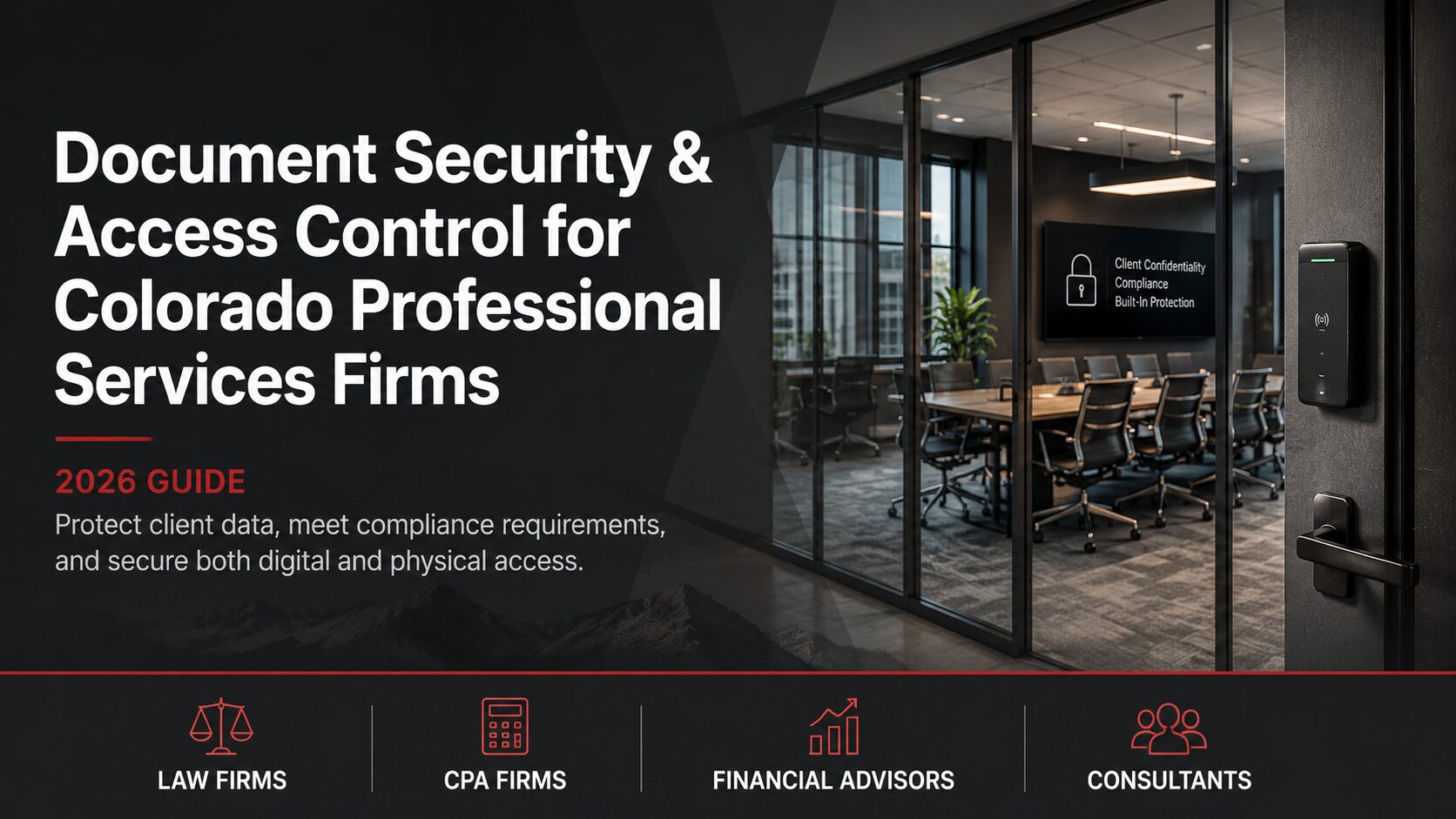
Quick Answer
Colorado professional services firms need layered security covering both digital access — who can open, print, or share client files — and physical access — who can enter your building, server room, or records area. A managed IT provider handling both through one platform creates the unified audit trail that regulators, cyber insurers, and enterprise clients are increasingly requiring in 2026.
|
40% of businesses experienced a physical security breach in 2024 — and most traced back to an unlocked door or an unmonitored access point, not a sophisticated cyberattack. For professional services firms, that statistic lands differently: the data behind your doors is your clients’ most sensitive financial, legal, and personal information. |
Your clients hand you their most sensitive information — tax returns, litigation strategy, financial plans, M&A details. The assumption is that you are protecting it. In 2026, that means something much more specific than it did five years ago, and a lot of Colorado professional services firms are operating with a gap between what they think their security looks like and what it actually is.
We have been working with Front Range law firms, accounting offices, and consulting companies for 20 years. The pattern we see more than any other: firms that are technically sophisticated about their legal or financial work, but running on decade-old security assumptions when it comes to IT and physical access. That gap is where breaches happen.
This post breaks down exactly what document security and access control should look like for a Colorado professional services firm in 2026 — and where most firms have real work to do.
|
Is Your Client Data Actually Protected? ABT offers a free security assessment for Colorado professional services firms. We review document access controls, physical entry points, and cyber controls together — not in silos.
|
Why Document Security Is a Compliance Obligation, Not Just an IT Decision
For most industries, security is a best practice. For professional services firms, it is a professional obligation with real legal exposure attached — and the regulatory pressure has increased significantly in the last two years.
Colorado law firms. Colorado attorneys are bound by the Colorado Rules of Professional Conduct. Rule 1.6 addresses client confidentiality obligations, and Rule 1.1 addresses competence — including technology competence. The Colorado Bar Association has issued guidance making clear that cybersecurity is part of that competence obligation. An attorney who stores client files on an unencrypted device, fails to implement MFA, or leaves physical records accessible to unauthorized individuals has a professional conduct problem, not just an IT problem.
Accounting and CPA firms. The FTC Safeguards Rule — updated in 2021 with key provisions taking full effect June 9, 2023 — classifies CPA firms and tax preparers as financial institutions under the Gramm-Leach-Bliley Act. That means a mandatory Written Information Security Plan (WISP), a designated qualified individual overseeing the security program, MFA on all systems accessing customer information, access controls, encryption, and tested backup and recovery procedures. A 2023 amendment added a 30-day breach notification requirement for incidents affecting 500 or more consumers. Fines run up to $100,000 per violation.
Financial advisors and RIAs. SEC Regulation S-P requires safeguards for customer financial records, documented incident response, and breach notification procedures. FINRA-registered firms face additional examination requirements around cybersecurity controls.
Consulting firms. Even businesses outside regulated industries face contractual security obligations from enterprise clients. Procurement teams now routinely require documented security practices and completed questionnaires before approving vendors.
| Firm Type | Governing Obligation | Key Requirements | Consequence of Gap |
|---|---|---|---|
| Law Firm | CO Rules of Professional Conduct 1.1, 1.6 | Encrypted client comms, access-controlled file systems, MFA, documented security practices | Bar discipline, malpractice exposure, client loss |
| CPA / Accounting | FTC Safeguards Rule (GLBA), IRS Pub. 4557 WISP | Written WISP, qualified individual, MFA, access controls, encryption, 30-day breach notification | FTC fines up to $100K/violation, enforcement action |
| Financial Advisor / RIA | SEC Regulation S-P, FINRA rules | Customer record safeguards, incident response plan, breach notification, exam readiness | SEC/FINRA findings, civil liability, registration risk |
| Consulting / Other | Client contracts, Colorado Privacy Act | Documented controls, vendor questionnaire readiness, data handling procedures | Contract loss, client breach liability, CO AG notification |
Digital Document Security: The Core Stack
Digital document security is not one tool — it is a layered system where each component has a specific job and a specific accountability chain.
|
The Core Stack Identity management (who you are) → Endpoint protection (what device you are on) → Document access controls (what you can open) → Encryption in transit and at rest → Audit logging (who did what, when) → Immutable backup (what happens when something goes wrong) |
|
Identity & Access Management MFA on every account, not just admin. Role-based access so an associate cannot reach partner-level files. Most Colorado firms on Microsoft 365 already have Entra ID available — most are not using it fully. |
Encrypted File Storage & Transfer Client files in encrypted cloud environments, not open shared drives. Documents to clients via encrypted portals, not email attachments. If you are emailing unencrypted PDFs of tax returns or contracts, that is an active exposure. |
|
|
Endpoint Detection & Response (EDR) Every device that touches client data needs EDR installed and monitored. EDR catches behavioral indicators that antivirus misses. Managed by your MSP means monitoring is continuous and response does not depend on your staff catching the alert. |
Audit Logging & Immutable Backup Complete records of who accessed what, when. Required on-demand under the FTC Safeguards Rule. Paired with immutable offsite backup that has been actually tested — not just assumed to work. |
Physical Access Control for Professional Services Offices
Digital security gets most of the attention, but physical access is where a significant number of breaches originate. Someone tailgating through a propped door. A former employee whose keycard was never deactivated. A contractor who needed server room access during a buildout and was never removed six months later. These are patterns we see regularly in Front Range professional services offices.
| Area | Why It Matters | What Modern Access Control Provides |
|---|---|---|
| Main entry / reception | First line of defense; visitor management and after-hours control | Credential-gated entry, visitor log, entry camera, time-based restrictions |
| Server / network room | Physical hardware access bypasses most digital security controls | Separate restricted credential, full entry audit log, dedicated camera |
| Records room / file storage | Physical client files carry the same exposure as digital ones | Restricted credential access, documented log of every entry |
| Partner / executive offices | Confidential conversations and documents require physical privacy | Scheduled access windows, audit trail for compliance review |
| After-hours / weekends | Most unauthorized physical access events occur outside business hours | Time-based restrictions, instant mobile alert on door breach, continuous recording |
|
The Offboarding Problem When an employee leaves, their digital credentials need to be revoked within the hour — and their physical access credentials deactivated at the same time. Traditional keycard systems require a manual pull that often does not happen for days. Cloud-managed access control lets you deactivate any credential from your phone in under 30 seconds, from anywhere. For a law firm or accounting office, that is a compliance control, not a convenience feature. |
The Gap Nobody Talks About: Where Digital and Physical Overlap
Most Colorado professional services firms run split-vendor security: an MSP for network and IT, a separate security company for cameras and door locks, building management handling anything in the common areas. Nobody talks to each other.
After a security event, no one owns the investigation. The IT vendor points to physical access. The security company says the network was involved. You are stuck reconstructing what happened from three disconnected systems — if the logs exist at all.
There is also a practical gap in the controls themselves. A former employee whose network credentials were revoked immediately but whose building badge was not deactivated for a week can still access physical records. A contractor with legitimate IT access has no business in the server room after hours — but if physical access is not managed in coordination with IT access, that restriction does not exist.
|
One platform. One audit trail. One accountable vendor. |
When digital and physical security are managed through one platform by one accountable vendor, you get unified audit logging, coordinated offboarding, and a single point of contact for incident response. For a firm that may need to demonstrate its security posture to a regulator, an insurer, or an enterprise client — that unified record is worth more than the sum of its parts. |
How Verkada Works for Colorado Professional Services
ABT is an authorized Verkada partner. We use Verkada for professional services clients because the platform addresses the integration problem above — access control, video surveillance, and alerting all in one cloud-managed dashboard, connected directly to our managed IT environment. No on-site DVR, no server to fail, all locations managed from one login.
| Verkada Feature | What It Does | Professional Services Value |
|---|---|---|
| Cloud-managed access control | Credential management from any device, no on-prem server required | Instant remote offboarding. Multi-site management from one dashboard. |
| HD camera system | Cloud-stored video, searchable by time, person, or event | Incident documentation for insurance claims and regulatory response |
| Badge event + video correlation | Door access event automatically tied to camera footage | Complete audit trail — who entered, at what time, what they did |
| Mobile app management | Grant or revoke any credential from a phone in seconds | Manage after-hours access for contractors and events without being on-site |
| Real-time breach alerts | Push notification for forced door, failed credential, after-hours entry | You know about an incident as it happens, not the next morning |
|
See What Verkada Looks Like for Your Office ABT provides a free access control assessment — we review your current entry points, credential management, and camera coverage. No obligation.
|
Secure Printing: The Overlooked Vector
Most professional services firms think seriously about securing their network and their building. Almost none have thought seriously about their printers — and that is a consistent gap across law firms and accounting offices throughout the Front Range.
|
Unclaimed Print Jobs Confidential documents sitting in the output tray. Anyone walking past can read them. Pull printing — requiring badge or PIN before paper releases — is the standard fix. |
Hard Drive at End of Lease MFPs store document images locally. When the device goes back, that data goes with it unless a certified drive wipe is arranged. Most leases do not include this by default. |
Printer as Network Entry Point Unpatched MFP firmware is a documented attack vector. A printer on the same segment as workstations without current firmware creates an attack path that bypasses endpoint security. |
|
The Hardware Is Usually Fine ABT carries Canon, HP, Kyocera, and Xerox — all with enterprise-grade print security features available. The issue is almost never the hardware. It is whether the security features were enabled during deployment and whether they are being actively maintained. See our post on preventing print-based cyberattacks for a full breakdown. |
How ABT Handles This for Colorado Firms
ABT has been serving Colorado professional services firms since 2005 from three Front Range offices — Centennial/Denver, Colorado Springs, and Westminster. Our standard starting point is a free security gap review across three areas simultaneously:
| Assessment Area | What We Review | What You Receive |
|---|---|---|
| Digital / IT security | MFA enforcement, EDR coverage, encryption status, backup integrity, access role structure | Written gap report mapped to your compliance framework (ABA, FTC Safeguards, SEC) |
| Physical access control | Entry points, current credential management, camera coverage, offboarding process | Recommended access control layout and Verkada deployment plan |
| Print security | MFP firmware status, hard drive handling, network placement, pull printing config | Print security configuration recommendations and managed print options |
This assessment is free, written, and carries no obligation. Most firms find at least one gap they were not aware of.
For a deeper look at managed IT for legal practices, see our post on Managed IT Services for Colorado Law Firms. For the broader cybersecurity picture, see our 2026 Colorado Cybersecurity Guide.
|
Ready to Close the Gaps? Free security assessment covering digital access, physical entry, and print security — reviewed together. Serving Denver, Colorado Springs, and Westminster.
|
Frequently Asked Questions
|
What does document security mean for a Colorado law firm? Controlling who can access client files digitally and physically, encrypting data in transit and at rest, maintaining complete audit logs, and enforcing MFA. Under Colorado Rules of Professional Conduct 1.1 and 1.6, these are professional requirements, not optional best practices. |
Does the FTC Safeguards Rule apply to Colorado CPA firms? Yes. Full compliance was required by June 9, 2023. Requirements include a Written Information Security Plan, MFA on all systems, access controls, encryption, and 30-day breach notification for incidents affecting 500 or more consumers. Fines run up to $100,000 per violation. |
|
|
What is pull printing and why does it matter? Pull printing holds a job in the queue until the user authenticates at the printer before the document physically prints. This prevents confidential client documents from sitting unclaimed in the output tray. Most current Canon, HP, Kyocera, and Xerox MFPs support it when properly configured. |
Can one vendor handle IT security and physical access control? Yes — and for most professional services firms, consolidating vendors is the stronger posture. Unified audit logging, coordinated offboarding, and one accountable party when something goes wrong. ABT handles both through managed IT and Verkada access control for Denver, Colorado Springs, and Westminster firms. |
|
|
How quickly can ABT deploy access control for a Colorado office? Single-office deployments typically install and configure within one to two business days after the initial assessment. Multi-location deployments use the same cloud platform, so all Front Range offices are managed from one dashboard from day one. |
What should be in a WISP for a Colorado accounting firm? Under the FTC Safeguards Rule: a designated qualified individual, documented risk assessment, digital and physical access control policies, encryption requirements, MFA enforcement, a vendor management program, an incident response plan, employee training, and periodic reporting to firm leadership. ABT can help build and document this as part of a managed IT engagement. |
Related ABT Resources
Wendy Campbell
Director of Marketing · Automated Business Technologies
Wendy leads marketing at ABT, focusing on cybersecurity education, managed IT services, and technology strategy for Colorado businesses. ABT has served Front Range organizations since 2005 with offices in Centennial/Denver, Colorado Springs, and Westminster. Reach her at wcampbell@yourabt.com.