Managed IT Services for Colorado School Districts: The FY2026–2030 E-Rate Reset
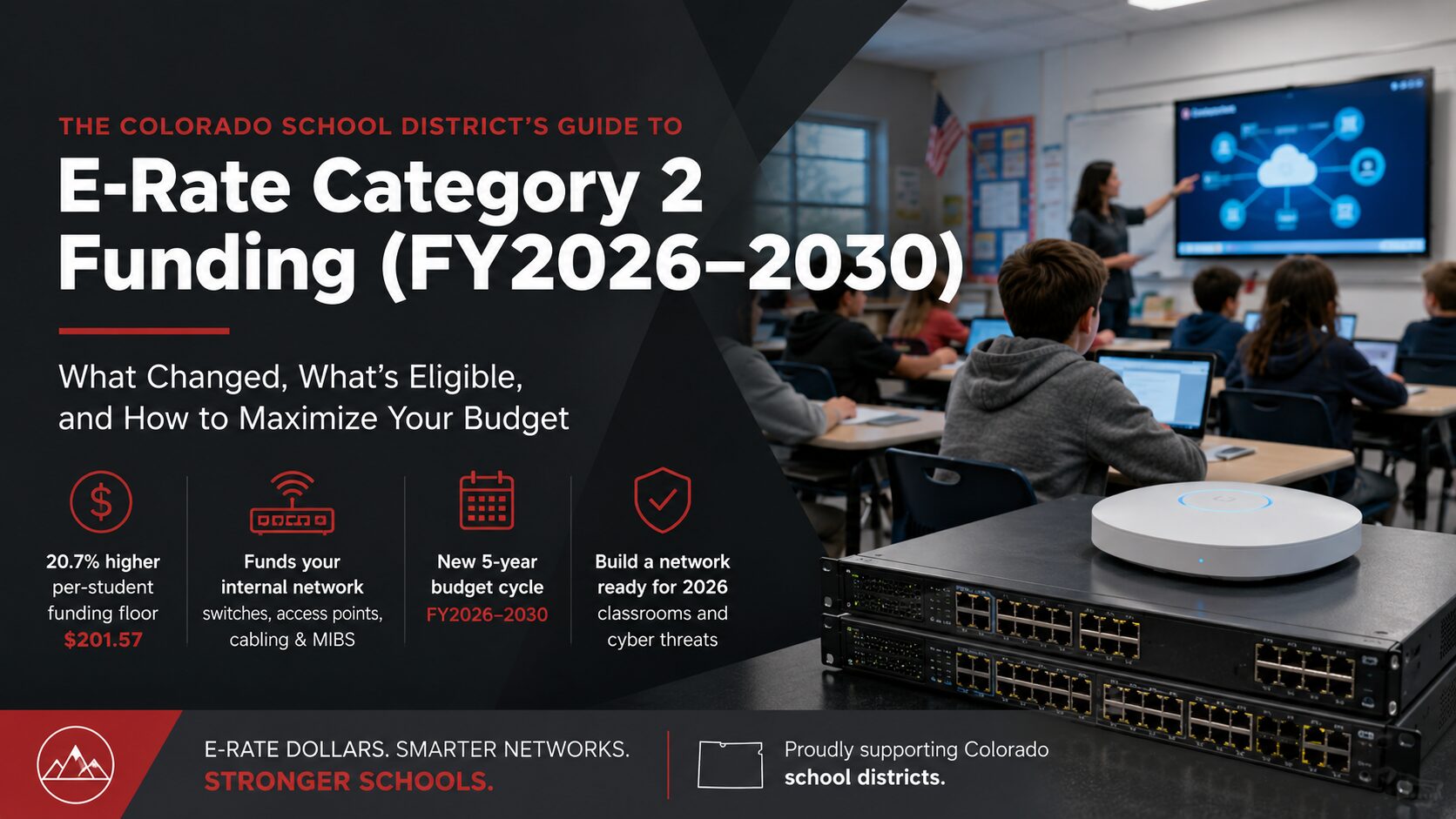
| QUICK ANSWER: Colorado school districts just entered a new five-year E-Rate Category 2 budget cycle (FY2026–2030), with the per-student funding floor rising 20.7% to $201.57. That budget covers the internal network layer — switches, access points, structured cabling, and Managed Internal Broadband Services (MIBS) — which lines up directly with the network refresh and managed IT work districts need anyway. This guide covers what changed, what’s eligible, and how ABT helps Colorado districts turn E-Rate dollars into a network that’s actually ready for 2026 classrooms. |
ON THIS PAGE
Why school district IT is a different problem
What just changed: the FY2026–2030 E-Rate reset
What Category 2 actually pays for
The 3–5 year refresh window — and why front-loading matters
Where this overlaps with cybersecurity and CIPA
Physical security and print budgets tie in too
What ABT actually does
Colorado coverage
FAQs
Why school district IT is a different problem
What just changed: the FY2026–2030 E-Rate reset
What Category 2 actually pays for
The 3–5 year refresh window — and why front-loading matters
Where this overlaps with cybersecurity and CIPA
Physical security and print budgets tie in too
What ABT actually does
Colorado coverage
FAQs
Why school district IT is a different problem
Running IT for a Colorado school district isn’t the same job as running IT for an office. A district network has to support hundreds or thousands of devices that turn over every August, a threat landscape aimed squarely at K-12 (ransomware crews know districts can’t afford downtime during the school year), student data privacy obligations that don’t exist in most commercial environments, and a budget cycle built around bond votes and mill levies — not quarterly earnings.
That’s exactly why the federal E-Rate program exists, and why the changes that took effect for Funding Year 2026 matter more than most districts’ IT teams have had time to unpack. If your last network refresh predates the pandemic, or your Category 2 budget has felt too small to do anything meaningful with, the reset that just happened changes that math.
What just changed: the FY2026–2030 E-Rate reset
The FCC moved E-Rate Category 2 — the bucket that funds internal network infrastructure — onto a new five-year budget cycle covering Funding Years 2026 through 2030. Districts validate their student counts in the first year they apply during this cycle, and that number sets the Category 2 budget for all five years.
| KEY POINT: The per-student Category 2 funding floor increased 20.7% to $201.57 for the FY2026–2030 cycle, and the standard funding floor for schools rose to $30,175, per USAC’s official Category Two Budget figures. For a mid-size Colorado district, that’s a meaningfully larger five-year budget than the previous cycle — enough to fund a real network refresh instead of patching around aging switches one more year. |
The FY2026 Form 471 application window ran January 21 through April 1, 2026, so if your district filed, funding commitment decisions are landing now — over the summer. That puts most Colorado districts in execution mode this fall: money is (or will soon be) committed, and the internal connections work needs to actually happen. If your district didn’t file, or filed for less than the new floor supports, the smart move is starting the network assessment now so you’re ready for the next filing window rather than scrambling in the spring.
What Category 2 actually pays for
Category 2 funds the internal broadband layer — the equipment and services between where connectivity enters your building and where it reaches a classroom or office. That includes switches, wireless access points, structured cabling, and, importantly, Managed Internal Broadband Services (MIBS): third-party management, monitoring, and operation of those internal connections. In plain terms, that means a managed IT services model for your network infrastructure is E-Rate eligible — not just the hardware.
| Switches & Access Points Core and access-layer switching plus wireless coverage sized for 1:1 device programs, BYOD, and classroom collaboration tools. |
Structured Cabling The physical backbone that determines whether your next refresh is a clean upgrade or a multi-year headache. |
| Managed Internal Broadband Services Ongoing monitoring, management, and support of internal connections — the managed IT layer, delivered by a third party like ABT. |
Basic Maintenance Repair and upkeep of eligible internal connections components, including multiyear license and software costs when filed correctly. |
| BOTTOM LINE: Your E-Rate consultant handles the filing. ABT handles the part that actually touches your network — assessment, design, procurement coordination, installation, and the ongoing management that keeps it eligible and keeps it running. The two roles work together, not around each other. |
| Not sure what your Category 2 budget actually supports? ABT will map your current network against your funding and tell you what a real refresh looks like — no obligation.Get a Free IT Assessment |
The 3–5 year refresh window — and why front-loading matters
Core network hardware — switches, access points, cabling — typically has a three-to-five-year useful life. That timeline lines up almost perfectly with the new five-year E-Rate cycle, which is exactly why front-loading matters: districts that spend a larger share of their five-year Category 2 budget on hardware in Year 1 get a full refresh now, then use the remaining years for basic maintenance and ongoing managed services. Districts that spread hardware spending evenly across all five years often end up running equipment past its useful life before the cycle resets again.
| Year 1: Refresh Front-load hardware spend — switches, APs, and cabling sized for the next five years, not the last five. |
Years 2–4: Manage Use remaining budget for basic maintenance and Managed Internal Broadband Services — keeping the refresh running without new capital spend. |
Year 5: Plan Assess again before the next five-year cycle opens, so you’re not filing blind. |
Where this overlaps with cybersecurity and CIPA
| A network refresh is also a compliance opportunity. CIPA filtering requirements, the Colorado Privacy Act’s data controller obligations, and cyber insurance underwriting all touch the same network layer Category 2 funds. New switches and access points are a natural point to implement network segmentation (separate staff, student, and guest VLANs), tighten wireless access policy, and close gaps an insurer or auditor would flag. We covered the compliance side in detail in our Colorado School District Cybersecurity Requirements guide — worth reading alongside this one if your refresh and your security review haven’t been connected yet. |
Physical security and print budgets tie in too
E-Rate dollars don’t touch access control or print, but districts planning a network refresh are usually looking at the whole campus budget picture at the same time. If badge-based entry, print security, or scan workflows are also on your list this year, our Access Control + MPS: Print Security for Colorado Schools guide covers that ground, and our Education Solutions hub maps out how the network, security, and print pieces fit together for a single campus or a full district.
| Planning next year’s budget across network, security, and print? One assessment covers all three — so you’re not making three separate calls.Talk to ABT About Your Campus |
What ABT actually does
ABT isn’t your E-Rate filing consultant — we work alongside whoever handles your Form 470/471 process. Our job is the technology itself: making sure the network you’re funding is the network your district actually needs, and making sure it stays that way after the installers leave.
| 1. Assessment Map current switches, APs, cabling, and coverage gaps against your Category 2 budget and district growth plans. |
2. Design Right-size a refresh for 1:1 programs, BYOD, and classroom collaboration — not just a like-for-like swap. |
3. Install Coordinate procurement and installation on a school-friendly timeline — summer breaks, weekends, minimal classroom disruption. |
4. Manage Ongoing monitoring and support as Managed Internal Broadband Services — keeping the network eligible, secure, and running. |
Colorado coverage
ABT supports districts, charter schools, private schools, and higher-ed campuses across the Front Range from three local offices: Centennial/Denver HQ, Colorado Springs, and Westminster. Multi-campus districts get one point of contact and standardized configurations across every building — not a different vendor per site.
| Ready to map your Category 2 budget against a real network plan? Share your device counts, campus count, and current network age — we’ll tell you what a right-sized refresh looks like.Get a Free IT Assessment → |
FAQs
| What is E-Rate Category 2, and how does it relate to managed IT services? Category 2 is the part of the federal E-Rate program that funds internal network infrastructure — switches, access points, cabling, and Managed Internal Broadband Services. MIBS specifically covers third-party management of that network, which is why a managed IT services model is directly relevant to how districts use this funding. |
Did the E-Rate Category 2 budget really increase for FY2026? Yes. The FCC’s new five-year cycle (FY2026–2030) raised the per-student Category 2 funding floor 20.7% to $201.57, with the standard school funding floor rising to $30,175. |
| What if our district already filed for FY2026 or missed the window? The FY2026 Form 471 window closed April 1, 2026. If you filed, focus now on executing the approved work before the funding year’s service deadlines. If you didn’t file, or filed conservatively, start your network assessment now so you’re ready for the next window. |
Are managed IT services actually E-Rate eligible? Managed Internal Broadband Services (MIBS) — third-party operation, management, and monitoring of eligible internal connections — are eligible under Category 2. Your E-Rate consultant confirms specific eligibility for your filing; ABT designs and delivers the technology side. |
| How does a network refresh interact with cybersecurity and CIPA compliance? A refresh is a natural point to rebuild network segmentation, tighten wireless policy, and address gaps that show up in CIPA and cyber insurance reviews. See our Colorado School District Cybersecurity Requirements guide for the compliance detail. |
What’s the difference between what ABT does and what our E-Rate consultant does? Your E-Rate consultant handles Form 470/471 filing and USAC compliance. ABT handles the network itself — assessment, design, installation, and ongoing management — coordinated with your consultant’s eligibility requirements. |
| Do you work with charter and private schools, or only public districts? ABT supports Colorado K-12 districts, charter schools, private schools, and higher-ed campuses. E-Rate eligibility rules differ by institution type — your consultant can confirm what applies to you; ABT can support the network regardless. |
How do we get started? Request a free IT assessment. We’ll review your current network, device counts, and campus footprint, then map out what a right-sized refresh looks like against your Category 2 budget. |
Wendy Campbell
Director of Marketing, Automated Business Technologies
Wendy leads content and marketing strategy for ABT, covering managed IT, cybersecurity, access control, and print solutions for Colorado businesses, schools, and healthcare organizations since 2005.
Director of Marketing, Automated Business Technologies
Wendy leads content and marketing strategy for ABT, covering managed IT, cybersecurity, access control, and print solutions for Colorado businesses, schools, and healthcare organizations since 2005.