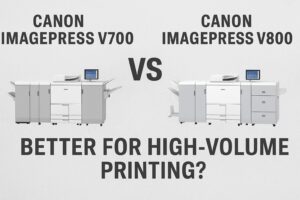
Quick Answer: V700 or V800 for high-volume printing?
For print volumes above 180,000 pages per month, the Canon imagePRESS V800 is the better choice — it delivers 80 ppm versus the V700’s 70 ppm, carries a higher duty cycle (400,000 vs. 350,000 pages/month), and is engineered for sustained heavy output. The V700 is the smarter investment for operations running under 150,000 pages per month where lower acquisition cost matters more than maximum throughput.
When you’re investing in a digital production press for high-volume printing, choosing between the Canon imagePRESS V700 and the Canon imagePRESS V800 can feel like splitting hairs — they’re part of the same lineup, share the same 2,400 × 2,400 dpi resolution, and are both built for demanding environments. But when you look closer, the differences directly impact how efficiently your operation handles throughput, job queues, and long-term cost.
This guide breaks down performance, duty cycle, workflow efficiency, and total cost of ownership across both models — so whether you run a print department in Denver, manage marketing production in Boulder, or oversee enterprise document output across Colorado, you leave with a clear answer.
Understanding the Canon imagePRESS V-Series
Canon’s imagePRESS V-series is not an office copier line — these are production-class color presses engineered for precision output under demanding workloads. Typical use cases include marketing collateral, brochures, catalogs, direct mail, booklets, and brand-consistent corporate documents that cannot tolerate color drift between runs.
The V700 and V800 occupy the mid-range tier of the series: compact enough for in-plant environments, powerful enough for full production workloads. They share a common foundation — same toner technology, same media range, same inline spectrophotometer — but differ in the specs that matter most to high-volume operations: speed, duty cycle, and processing capacity.
Canon imagePRESS V700 vs V800: Specifications
The table below maps the key differences. Pay particular attention to print speed, recommended monthly volume, and duty cycle — those three numbers tell most of the story.
| Specification | Canon imagePRESS V700 | Canon imagePRESS V800 |
|---|---|---|
| Print Speed (8.5″ × 11″) | 70 ppm | 80 ppm |
| Print Resolution | 2,400 × 2,400 dpi | 2,400 × 2,400 dpi |
| Recommended Monthly Volume | Up to 190,000 pages | Up to 220,000 pages |
| Maximum Monthly Duty Cycle | ~350,000 pages | ~400,000 pages |
| Paper Weight Range | 52–350 gsm | 52–350 gsm |
| Maximum Paper Size | 13″ × 51.2″ | 13″ × 51.2″ |
| Input Capacity (fully configured) | Up to 10,400 sheets | Up to 10,400 sheets |
| Registration Accuracy | ±0.8 mm front-to-back | ±0.8 mm front-to-back |
| Color Management | Inline Spectrophotometer + Auto Calibration | Inline Spectrophotometer + Auto Calibration |
| Toner Type | Canon Translucent CV Toner | Canon Translucent CV Toner |
Where the V700 and V800 Actually Differ
The spec table shows the numbers. Here is what those numbers mean in a working production environment.
Speed and Daily Throughput
The V800’s 80 ppm versus the V700’s 70 ppm is a 14% performance difference that compounds quickly across a full workday. On a 10,000-page job, the V800 finishes roughly 14 minutes faster. Multiply that across multiple client runs per day and you are reclaiming meaningful production hours each week — hours that translate directly to capacity for additional jobs or faster turnaround commitments.
For operations with tight deadlines or overlapping print queues, that speed buffer matters. For a department printing a single steady job type below capacity, it likely does not.
Duty Cycle and Machine Longevity
This is the more important number for most buyers. Canon rates the V700’s recommended monthly volume at 190,000 pages; the V800 at 220,000 pages. Running a machine consistently near its rated ceiling — as a V700 would be at 200,000+ pages per month — accelerates wear on imaging components, increases service frequency, and shortens effective machine life. The V800 carries genuine headroom at that volume level.
If your operation is comfortably below 150,000 pages per month, the V700 runs well within its designed range. If you are pushing past 175,000 and expect that to continue or grow, the V800 is the operationally correct choice — not just a nice upgrade.
Color Consistency on Long Runs
Both machines use Canon’s Inline Spectrophotometer (ILS), Multi-Density Adjustment Technology (Multi-DAT), and Translucent CV Toner — the same core color engine. For most jobs, output quality is essentially identical between the two models.
The distinction appears on sustained long runs. Because the V800 is calibrated for higher continuous throughput, it maintains color stability slightly better under extended workloads. For brand-critical color work — particularly jobs where the first sheet and the ten-thousandth sheet need to match — that consistency edge is real and measurable.
Workflow Processing and Job Queues
The V800’s enhanced processing engine handles larger simultaneous job queues more efficiently. In a production environment running 8–10 large jobs per day through a Fiery controller, that additional headroom reduces idle time between runs and bottlenecks during peak periods. Both machines integrate into standard digital workflows, variable data printing, and automated finishing — the V800 simply handles the load with less strain on the processing side.
Media Flexibility
On this dimension, both models are effectively equal. Each supports 52–350 gsm paper weights, long-sheet capability to 13″ × 51.2″, coated and uncoated stocks, textured and specialty media, automatic duplex, and optional finishing modules including saddle stitchers, binders, and hole-punch units. If your primary question is about media range rather than volume capacity, either machine will handle your requirements.
Which Model Is Right for Your Operation?
The right choice comes down to your current monthly volume and where you expect to be in two to three years. Use this as your decision framework:
| Your Situation | Recommended Model |
|---|---|
| Print volume under 150,000 pages/month | V700 |
| Print volume 180,000–220,000+ pages/month | V800 |
| Expecting significant growth in print demand | V800 |
| Primarily smaller or mixed job types | V700 |
| Long, full-color production runs with brand-critical consistency | V800 |
| Lower acquisition cost is the priority today | V700 |
| Lower cost per page and longer lifecycle matter more | V800 |
The short version: the imagePRESS V700 is the right machine for medium-volume, high-quality production environments that do not need — and should not pay for — maximum throughput capacity. The imagePRESS V800 is the clear choice for operations where volume is high, deadlines are tight, and the cost of downtime or unplanned service is real.
A note on total cost of ownership
The V700 carries a lower upfront cost and slightly lower baseline operating costs. If your volume stays comfortably below 150,000–175,000 pages per month, it is the better financial decision. But if you are consistently printing 200,000+ pages and the V700 is operating near its rated ceiling, the increased service frequency and accelerated wear will quickly offset the acquisition savings. At that volume, the V800’s higher upfront cost becomes the more economical choice over a 3–5 year ownership period.
Service and Support in Colorado
Both the V700 and V800 are built on Canon’s reliable engineering and share the same support network. In Colorado, that means working with a local authorized Canon partner who can guarantee same-day or next-day response, keep toner and parts in regional stock, and provide preventive maintenance before problems occur — not after your press goes down mid-job.
ABT serves Denver, Colorado Springs, Westminster, and the broader Front Range with dedicated production press support teams. If you are deploying a V-series press at volume, local service coverage is not a secondary consideration — it is part of the total cost calculation.
Get a Personalized Assessment for Your Colorado Operation
Not sure which model fits your workflow? ABT’s production print specialists will review your current monthly volume, job types, and growth timeline — then recommend the right device, configuration, and service plan. Whether you’re producing 100,000 or 400,000 pages a month, the goal is a system that drives productivity, reduces downtime, and delivers a clear ROI.
→ Request a Free Print Assessment | Call: 303-778-0600