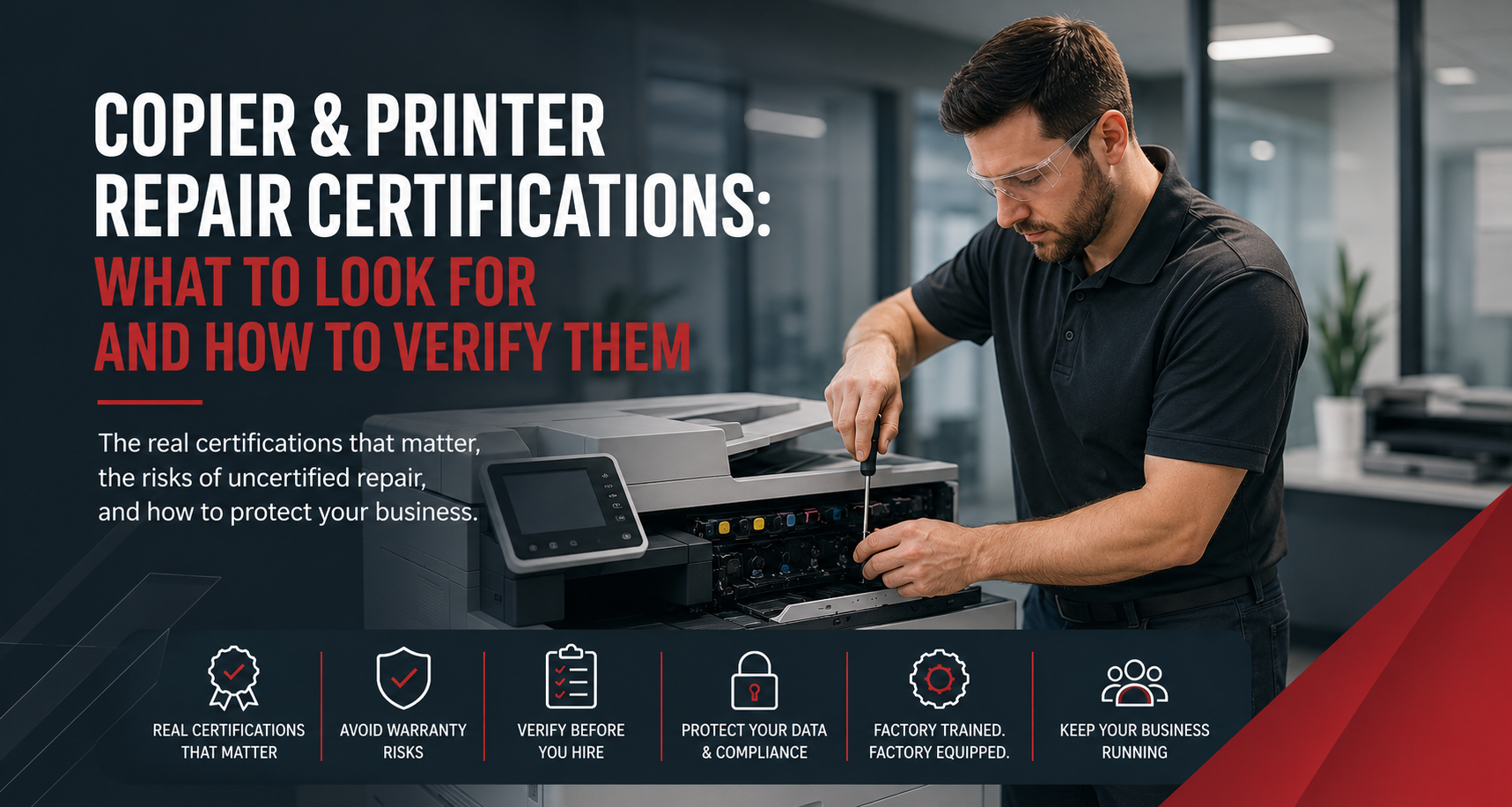
Why Printer Repair Certifications Actually Matter
When a copier or printer goes down, it’s tempting to call whoever answers the phone fastest. But manufacturer authorization programs exist for a real reason: they control who gets access to factory training, genuine parts, current firmware, and diagnostic tools. A technician without that access is troubleshooting blind on anything beyond a paper jam.
For Colorado businesses in healthcare, legal, or finance, this isn’t just a performance question — it’s a compliance one. Non-authorized repair on a device that stores or transmits PHI or client financial data can create a security gap that has nothing to do with the mechanical fix.
Copier & Printer Repair Certifications: The One With a Public Name — Canon ATSP
Canon’s dealer-technician certification program is called ATSP — Association of Technical Service Professionals. It’s administered directly by Canon U.S.A., requires passing a series of proprietary exams, and is awarded to individual technicians at authorized dealerships — not to the dealership as a whole. ABT is a Canon authorized dealer, and Canon’s own guidance is that repairs should go through factory-trained, ATSP-certified technicians using genuine parts.
This is the one credential in this space with a clean, public name you can ask about directly — most local repair shops won’t be able to produce one.
HP, Epson, Kyocera & Xerox: What Each Brand Actually Calls It
Not every manufacturer names its technician credential the way Canon does. Some publish a specific designation; others authorize the service provider directly. Here’s what’s actually documented for each brand ABT services.
| Kyocera Kyocera’s dealer-technician credential is SSP (Service Solutions Provider) designation, earned through post-sales training modules. A newer TDS (Total Document Solutions) Provider tier builds on top of SSP with additional pre- and post-sales training. Ask a Kyocera repair provider whether their technicians hold current SSP status. |
Xerox Xerox’s model runs through Authorized Service Provider status and, for some partners, DTPM (Designated Third Party Maintainer) status — rather than a single named technician-level acronym. Ask which of these applies to the provider you’re calling. |
| HP HP doesn’t publish a single printer-specific technician certification acronym the way Canon does. The credential that matters is HP Authorized Service Provider status, granted through HP’s own Channel Services Network. Note: “HP ASE” is a real HP credential, but it applies to HPE server and compute infrastructure — not printer repair. Don’t take that name at face value from a repair provider. |
Epson Same situation as HP — no distinct technician-level acronym on Epson’s own site. The verifiable claim is Epson Authorized Service Center status, which you can cross-check against Epson’s own service center locator. |
Warranty & Compliance Risk From Uncertified Repair
How to Verify a Technician’s Certification Before You Hire
| 1. Ask which brand(s) they’re authorized for Not “are you certified” — ask specifically: authorized by whom, for which product lines, and what the credential is called. |
2. Ask for documentation A legitimate authorized technician can produce a certificate, ID number, or point you to a manufacturer’s dealer locator. |
3. Cross-check with the manufacturer Canon, HP, and Epson all publish authorized dealer or service center locators you can check independently. |
What This Means for Your Total Cost of Ownership
Authorized, certified repair isn’t just about the individual fix — it reduces callbacks, protects warranty coverage, and catches problems (like a device nearing end-of-life) before they become expensive. This is the same logic behind bundling repair into a Managed Print Services plan rather than paying per incident indefinitely.
FAQs
| What certifications should I actually ask about? Ask which manufacturers the company is authorized by, for which product lines, and what the credential is called — Canon’s and Kyocera’s have public names; HP, Epson, and Xerox authorize the provider directly. |
Does Canon have an official certification program? Yes — ATSP (Association of Technical Service Professionals), administered directly by Canon U.S.A. to individual technicians at authorized dealers. |
| Do HP and Epson have named technician certifications like Canon’s? Not in the same way. Canon and Kyocera publish named credentials (ATSP and SSP/TDS). HP and Epson instead authorize service providers directly — the credential to ask about is “Authorized Service Provider” status, not a specific acronym. |
Will non-certified repair void my warranty? In most cases, yes. Manufacturer warranties typically require authorized service to remain valid. |
| Do I need a service plan to get certified repair? No — ABT provides certified repair on a per-visit basis or under a Managed Print Services plan, whichever fits your usage. |
How do I verify a technician’s certification before they arrive? Ask for a certificate or ID number, or check the manufacturer’s own authorized-provider locator independently. |
| Which brands is ABT authorized for? ABT is an authorized dealer for Canon, HP, Kyocera, Xerox, FUJIFILM, and Epson across the Front Range. |
Is “HP ASE” a printer certification? No. HP ASE (Accredited Service Engineer) is a real HP credential, but it covers HPE server and compute infrastructure — not printer or copier repair. |
Ready to Work With Certified Technicians?
| Need a repair now |